‘Reports are heard of brothers selling their homes and property and planning to finish out the rest of their days in this old system in the pioneer service. Certainly this is a fine way to spend the short time remaining before the wicked world’s end.’ (Kingdom Ministry, May 1974, p3)

| The Errors of Soul Sleep by Keith Piper |
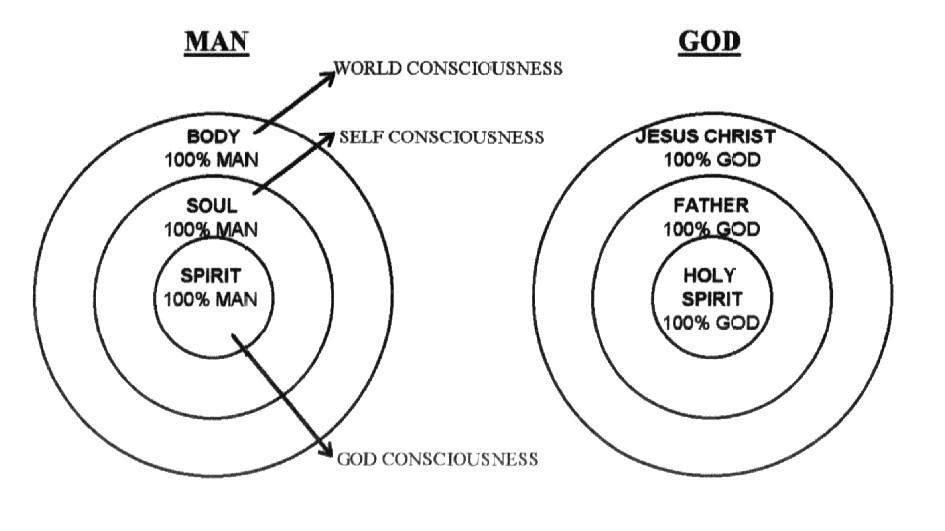
Question: Where do spirits go after death? Answer: The spirit and soul of a saved person go to heaven. The spirit of a lost person goes to hell. This happens immediately at death. The soul does not go to sleep, losing consciousness. The body sleeps in the grave, but the soul remains conscious, either in heaven or in hell. MAN'S MAKEUP IS BODY, SOUL and SPIRIT because: 1. Man's being consists of body, soul and spirit. "... I pray God your whole spirit and soul and body be preserved blameless unto the coming of our Lord Jesus Christ." (1 Thessalonians 5:23) 2. "The Word of God ... piercing even to the dividing asunder of soul and spirit, and of the joints and marrow." (Hebrews 4:12) This shows man's nature to be trichotomous: soul, spirit, body. 3. Paul discusses three kinds of men as natural (following body impulses), carnal (following soul impulses) and spiritual (following spiritual leading of the Holy Spirit). 4. "The Lord God formed man of the dust of the ground (body), and breathed into his nostrils the breath (spirit) of life; and man became a living soul (soul)". Genesis 2:7. It is not said that man became spirit and soul; but rather, that God inbreathed spirit, and man became a living soul. God's life took possession of clay, and as a result man had a soul. 5. God said, "Let us make man in our image, after our likeness ... so God created man in His own image, in the image of God created He him ..." (Genesis 1:26-27) As God has a spirit, soul and body, so does man have a spirit, soul and body, in God's image. As God is a Trinity, so is man a Trichotomous being. See example below:
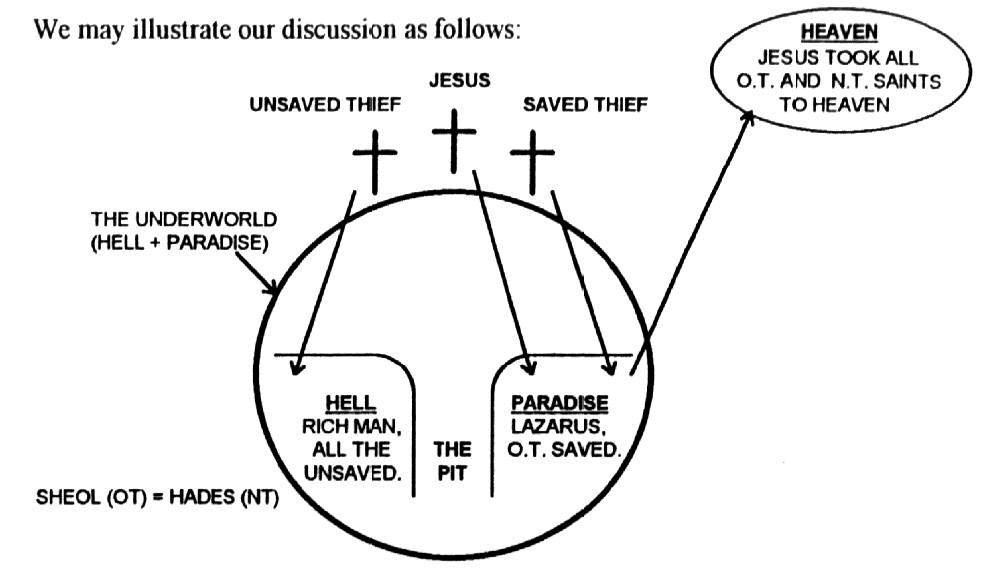
Note: The Holy Spirit corresponds to our spirit. Jesus Christ with a resurrection body corresponds to our body. As the Father directs the Son and Holy Spirit, so does the soul (mind) direct our body and spirit to obey its decisions. This explains how Jesus as God, obeys His Father, in the same way that our body obeys our mind's directives. Jesus Christ submits to the Father, and our body submits to our mind. Jesus Christ is still as 100% God as His Father, and our body is still as 100% human as our mind. WHAT HAPPENS TO US AFTER DEATH? At death, the soul and spirit leave the body. 1. Unbelievers. In the Old Testament, the spirit and soul of an unbeliever went immediately to the torment of hell, which is inside the earth. Notice these verses showing that people are conscious in hell, and that hell is inside the earth. 1. The sorrows of hell compassed me about. (Psalm 18:5) Note: Hell has sorrows. 2. The pains of hell got hold of me. (Psalm 116:3) Note: Hell has pains. 3. The wicked shall be turned into hell. (Psalm 9:17) Note: Hell is for the wicked. 4. It is as high as heaven ... deeper than hell. (Job 11:8) Note: Hell is deep. 5. A fire ... shall burn to the lowest hell. (Deuteronomy 32:22) Note: Hell has fire. 6. Hell and destruction are never full. (Proverbs 27:20) Note: Hell is like destruction. 7. Thou shalt beat him with the rod, and shalt deliver his soul from hell. 8. Hell from beneath ... stirs up the dead for thee. All they shall speak and say unto thee, art thou become weak as we? (Isaiah 14:9-10) Note: People's souls in hell can stir, speak and say. This proves that soul sleep is false for unbelievers. 9. Unto the nether (lower) parts of the earth, with them that go down into the pit. (Ezekiel 32:18) Note: The pit and hell are in the lower parts of the earth. 10. The strong among the mighty shall speak to him out of the midst of hell. Note: People in hell can speak, showing that they are not asleep. 11. The Zidonians which are gone down with the slain ... Pharaoh shall see them, and shall be comforted, even Pharaoh and all his army slain by the sword. (Ezekiel 32:30-31) Note: Pharaoh, after being killed in battle is comforted in hell by seeing the Zidonians, who have also been killed in battle, enter hell with him. People can see in hell, have comforting thoughts of other people suffering and thus, are not sleeping. 12. The rich man in Hell, could see, hear, taste and touch. Four times it says that he is tormented. "And in hell he lifted up his eyes, being in torments, and seeing Abraham afar off, and Lazarus in his bosom (v.23). And he cried and said, father Abraham, have mercy on me, and send Lazarus, that he may dip the tip of his finger in water and cool my tongue; for I am tormented in this flame (v.24). But Abraham said, ...now he (Lazarus) is comforted, and thou art tormented (v.25). Then he said, I pray thee therefore, father, that thou wouldest send him to my father's house: For I have five brethren; that he may testify unto them, lest they also come into this place of torment (v.28)." (Luke 16:19-31) 2. Old Testament Believers. In the Old Testament, the spirit and soul of a believer went immediately to the comfort of paradise in the lower parts of the earth. a) Now he (Lazarus) is comforted. (Luke 16:25) b) Jesus said unto him, verily I say unto thee, today shalt thou be with Me in paradise. (Luke 23:43) Note: The Jehovah's Witness translation of this verse is utterly childish. Jesus is supposed to have said, "verily I say unto thee today". Well of course He said it today. When else would He be saying it? Yesterday? "I say" is present tense. c) Samuel's spirit came up out of the earth after his death to tell Saul that tomorrow Saul, Jonathan and his other sons would be killed in battle, and would be with Samuel in paradise. "... The woman said to Saul, I saw gods ascending out of the earth ... What form is he of? And she said, an old man cometh up: and he is covered with a mantle. And Samuel said to Saul, Why hast thou disquieted me, to bring me up? ... Tomorrow shalt thou and thy sons be with me." (1 Samuel 28:12-19) Note: Samuel was resting in paradise in the earth, and resented Saul disturbing him by bringing him up. Samuel was not asleep, just resting, not soul sleep, but conscious.
By which also He went and preached unto the spirits in prison. (1 Peter 3:19) Jesus would not waste His time preaching to spirits imprisoned in the underworld if they were sleeping and could not hear Him. You only preach to those who are conscious.
3. New Testament Believers. In the New Testament, the spirit and soul of believers go immediately upon dying to heaven. We know this because of these reasons: a) To depart and to be with Christ in heaven is far better. "For I am in a strait betwixt two, having a desire to depart, and TO BE WITH CHRIST; which is far better." (Philippians 1:23) Paul desired to depart his body by dying, so that he could be with Christ IN HEAVEN, which is far better than staying on the earth. It is far better to go to soul consciousness with Christ in heaven. b) When we are absent from the body, we are present with the Lord in heaven. "... knowing that, whilst we are at home in the body, we are absent from the Lord: we are confident, I say, and willing rather to be absent from the body, and to be present with the Lord." (2 Corinthians 5:6, 8) When we are out of our body (death), we are present with the Lord. Where is the Lord now? In heaven. Therefore believer's spirits and souls go to heaven on dying. c) Spirits of just men made perfect are now in heaven. "But ye are come unto ... the heavenly Jerusalem ... to the general assembly and church of the firstborn, which are written in heaven, and to God the Judge of all, and to the SPIRITS of just men made perfect." (Hebrews 12:23-24) This clearly tells us that when believers die, their spirits go to heaven immediately. d) Christ at the Second Coming brings departed believers' souls with Him to the air. 1 Thessalonians 4:14 tells us that the spirits of believers who have died, are waiting in heaven until the day when Jesus Christ will bring their spirits and souls with Him at the second coming in the air to be rejoined with their resurrected bodies. "... them also which sleep in Jesus will God bring with Him." Their dead bodies, buried in the grave will be resurrected to rejoin their spirits and souls which Christ will bring with Him from heaven. Christ bringing their spirits and souls, shows that they are with Christ in heaven after death awaiting the resurrection. e) Souls of departed believers are in heaven crying out for revenge. After the rapture (catching away of believers to heaven) many people get saved in the seven year tribulation. Many of these are killed by the Antichrist. Do their souls go to soul-sleep in the grave? No! Their souls are seen under the altar in heaven: "I saw under the altar the SOULS of them that were slain for the word of God ... they cried with a loud voice, saying ..." (Revelation 6:9-10) These souls of dead believers are in heaven. They can cry out with a loud voice. They have memory of their death on earth, crying for revenge. They are not unconscious or soul-sleeping in the grave. Objection: Some verses come close to saying that the dead are unconscious (e.g. Psalm 30:9, 115:17, 146:4; Ecclesiastes 9:10; Isaiah 38:18-19). These say that a dead body can't praise God, but the soul is still alive. How do we understand these verses in the light of the vast majority of verses that teach that human souls are conscious after death? 1. "What profit is there in my blood, when I go down to the pit? Shall the dust praise thee? shall it declare thy truth? (Psalm 30:9) Answer: The Old Testament saints had a gloomy view of death. Death to them was seen as an interruption in their communion with God, even for believers. They saw death as a continuation of existence (Isaiah 14:9-11), but on terms which robbed it of all that deserves to be called life. David shared the common view, and he uses it as part of his appeal to God. 2. "The dead praise not the Lord, neither any that go down into silence. But we will bless the Lord." (Psalm 115:17) Answer: Jesus had not yet brought life and immortality to light through the Gospel. "But is now made manifest by the appearing of our Savior Jesus Christ, who hath abolished death, and hath brought life and immortality to light through the Gospel." (2 Timothy 1:10) Believers now have eternal life and an immortal soul. The Holy Spirit used Old Testament believers' limited understanding of the afterlife to urge them to praise God while they could. 3. "His breath goeth forth, he returneth to his earth; in that very day his thoughts6250 perish." (Psalm 146:4) Answer: When a person dies, his earthly plans, ambitions and thoughts perish with him. When you are dead, you cannot contribute anything to fulfill your earthly ambitions. "Thoughts" in Hebrew mean "polished, sleek, plans formed in the mind". "His thoughts perish" means that his ambitions perish. "Eshtonah"6250 from "ashath"6245 is only ever used of "thoughts" here in Psalm 146:4. "Thoughts" most commonly used in the Old Testament is "machashabah"4284, a different Hebrew word to that word used in Psalm 146:4. "Thoughts that perish" are the wicked man's plans and purposes which come to naught at his death. The thoughts which go to the grave are his vain projects. (e.g. the thoughts of the rich fool of building bigger barns and of many years of ease and prosperity.) All his selfish, worldly schemes, perished in that same night. (Luke 12:16-21). Luke 9:30-31 show that Moses and Elias lived after death to talk with Christ on the Mount Transfiguration. Luke 20:38 "He is not a God of the dead, but of the living: for all live unto Him." Colossians 3:2 The New Testament tells believers to "set your affections on things above." This means that we go to heaven at death. 4. "... the dead know not anything ..." (Ecclesiastes 9:5) Also their love, and their hatred, and their envy, is now perished." (Ecclesiastes 9:6) "There is no work, no device, nor knowledge, nor wisdom, in the grave where thou goest." (Ecclesiastes 9:10) Answer: Ecclesiastes 9:4, 6, 10 is written from the standpoint of knowledge "under the sun", from the viewpoint of natural man who lives without thoughts for God. This restates the philosophy of unbelievers that "when you're dead, you're dead." "For the grave cannot praise thee, death cannot celebrate thee: they that go down into the pit cannot hope for thy truth." (Isaiah 38:18) The term "sleep", when applied to death, refers to death of the body only. After the resurrection of Christ, believers went into the presence of Christ at their death. CONCLUSION. The "soul sleep" error is held by Seventh Day Adventists, Jehovah's Witnesses, and Christadelphians. Use these Scriptures to refute this error. |
It is not new the fact that joseph smith, the founder of the mormon cult was arrested for "glass looking".
This was taking money from people and pretending to "see" by occult means treasure buried on that persons' land.
But, what mormons WON'T tell you is that joe was not only arrested but CONVICTED of this crime.
They will say he was arrested and not convicted, or they will play the "persecution" or "people had a grudge against him" cards.
Now, these mormons are either ignorant of the incident or are flat out lying to you.
Here i present PROOF by witnesses and OFFICIAL COURT DOCUMENTS which has been discovered that prove beyond a shadow of a doubt that joe was a con-man.


Hiel and Joseph Lewis: "Some time previous to 1825, a man by the name of Wm. Hale, a distant relative of Uncle Isaac Hale, came to Isaac Hale and said that he had been informed by a woman by the name of Odle, who claimed to possess the power of seeing under ground (such persons were then commonly called peepers), that there were great treasures concealed in the hill northeast from Isaac Hale's house, and by her directions Wm. Hale commenced digging. But, being too lazy to work and too poor to hire, he obtained a partner by the name of Oliver Harper, of New York State, who had the means to hire help. But after a short time operations were suspended, for a time, during which Wm. Hale heard of PEEPER Joseph Smith, jr., and wrote to him and soon visited him, and found Smith's representations were so flattering that Smith was either hired or became a partner with Wm. Hale, Oliver Harper and a man by the name of Stowell, who had some property. They hired men and dug in several places.”
"But while he was engaged in looking in his peep-stone and old white hat, directing the digging for money, and boarding at Uncle Isaac Hale's, he formed an intimacy with Mr. Hale's daughter, and after the abandonment of the money-digging speculation, he consummated the elopement and marriage to the said Emma Hale, and she became his accomplice in his humbug Golden Bible and Mormon religion.". Ibid. p. 78, 79. Close relatives of Emma Hale Smith.